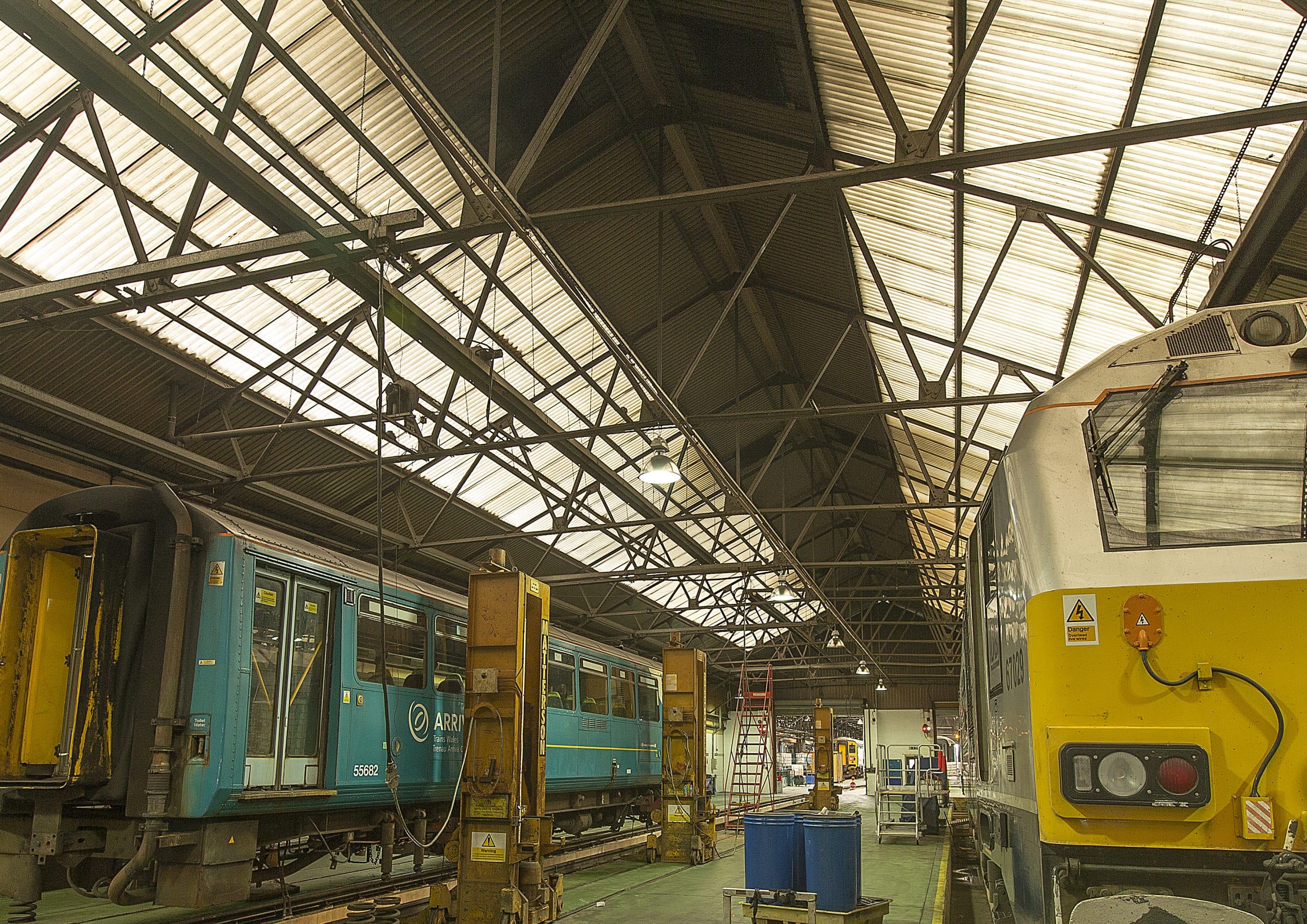
Inspection-pit lighting at Arriva Trains Wales: a retro-fit case
An unusual lighting environment
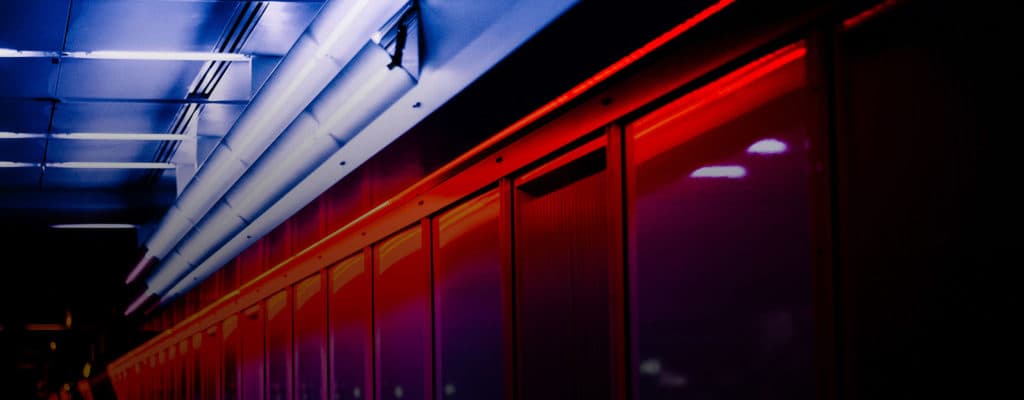
A train inspection pit is the channel beneath a maintenance road that gives engineers access to underbody equipment. Pit lighting has to satisfy a brief that doesn't appear anywhere else in our work:
- Tight ceiling clearance — fittings sit only a few hundred millimetres below the rolling stock that passes overhead.
- High mechanical exposure — passing wheels, falling tools, occasional jets of cooling water and oil.
- Long, narrow geometry — the pit is essentially a corridor with a job at the top of it.
- Continuous-shift operation — depots run 24/7; the lighting can't be switched off for replacement work.
- Existing fluorescent legacy — older pits run T5 or T8 fluorescent strip lights. The existing housings are often built into the concrete and not removable.
The Arriva Trains Wales brief
The operator's existing scheme used T5 fluorescent strip lighting end-to-end through several pits. Three problems had stacked up over time:
- Energy consumption was high — fluorescent fittings on continuous duty consume more than equivalent LED.
- Maintenance burden was high — lamp replacement and ballast failure at frequencies that the depot's maintenance team could no longer absorb.
- Lux levels had drifted down as fittings aged, to the point where engineers were struggling to see underbody details on certain rolling stock.
Full replacement was off the table — the housings were structural and integrated into the pit walls. The brief was to retrofit a higher-output, lower-maintenance LED solution into the existing physical envelope.
What we did
Morgan Hope produced a custom retrofit gear-tray solution using our LedLite Linear PCB platform. Three things were specific to this project:
- Asymmetric optic. Pit lighting needs to throw light upward and outward toward the rolling stock, not downward into the channel floor. We specified a 60° / 90° asymmetric optic that delivers most output above horizontal.
- Mechanical protection. Toughened polycarbonate diffuser rated for the impact and chemical exposure environment. The standard LedLite diffuser would have been adequate for a workshop floor but not for the continuous operating environment of a depot pit.
- Driver location. Drivers were located outside the pit envelope, in a serviceable enclosure that could be reached without entering the pit. This decoupled the highest-failure-rate component from the most-difficult-to-access location.
What changed for Arriva
Three outcomes the operator measured after install:
- Maintenance frequency dropped substantially. Lamp replacement events stopped; driver replacement events were significantly less frequent than the original ballasts.
- Lux levels increased versus the original scheme on day one and stayed above the original specification through the warranty period.
- Energy consumption decreased materially versus the original fluorescent baseline. Exact figures appear in the case study PDF.
Where this approach generalises
This is a niche application but the pattern is general: legacy fittings that can't be removed, environments where standard LED retrofit kits don't fit the brief, and operators who need to reduce maintenance burden without the disruption of a full re-fit.
We've used the same LedLite Linear PCB platform with custom optical, mechanical, and driver-location decisions on:
- Workshop pits in heavy-vehicle maintenance facilities
- Underfloor cable troughs in industrial buildings
- Confined-space service ducts where standard LED fittings can't be installed safely
If you have a legacy lighting environment that doesn't suit off-the-shelf fittings, the right starting point is usually a survey rather than a brochure.
The full Arriva Trains Wales case study PDF is available on our website under Bespoke. For project enquiries, our bespoke team handles retrofit briefs across rail, automotive, and industrial inspection environments.