Solar lighting for car parks: lessons from APCOA Wigan
The brief
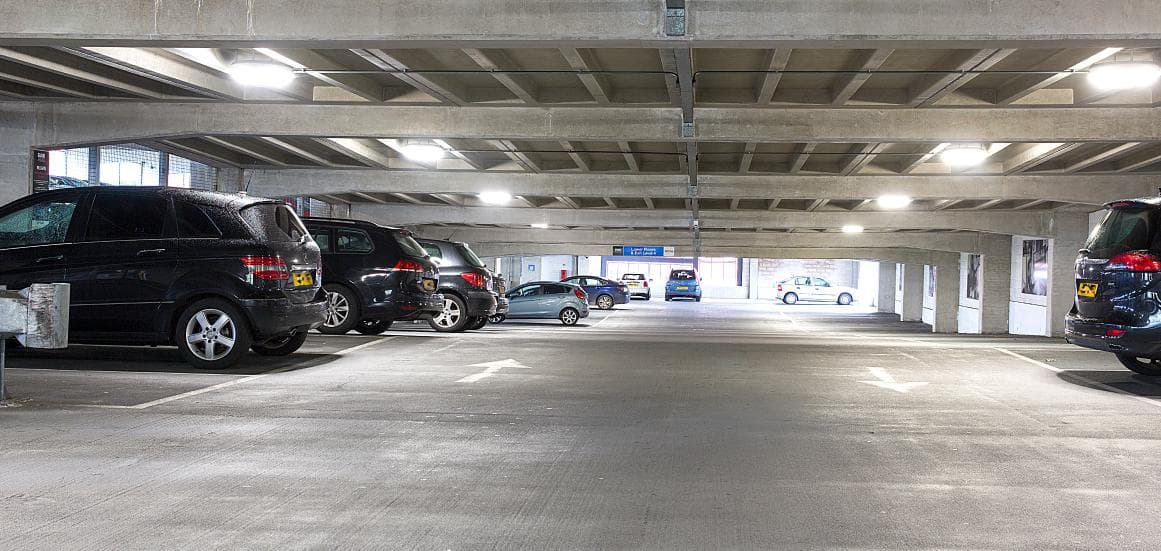
APCOA operates the Grand Arcade Car Park in Wigan as part of its UK estate. The site brief was straightforward in headline terms: enhance lighting output, add compliant emergency lighting, reduce energy use, and reduce maintenance overhead. In practice every one of those four objectives is in tension with the others on a multi-storey car park.
Why these projects are hard
Three characteristics make multi-storey car park lighting difficult:
- Mixed luminance environment. Daylight floods the perimeter while internal cores stay dark. Sensors and controls have to handle both without cycling.
- High maintenance access cost. Reaching ceiling-mounted fittings on a deck above an active vehicle floor needs scaffolding or MEWPs, which means every replacement event costs more than the fitting itself.
- Mixed compliance regimes. Some areas need emergency lighting to BS 5266; pedestrian routes need different uniformity criteria from vehicle routes; security cameras impose a colour-rendering minimum that pure efficiency optimisation tends to violate.
The Morgan Hope approach
For APCOA Wigan we specified a combination of the following elements:
- Astrid HighLite XL as the primary fitting on the deck soffits — wide optic, high efficacy, IP-rated for the operating environment.
- Battery-backed emergency conversion on every third fitting along marked escape routes, supplied with the original specification rather than retrofitted.
- PIR + daylight sensing controls at the deck perimeter, configured for graceful degradation under fog and rain conditions where naïve sensing triggers oscillation.
- Solar-supplemented exterior lighting for the rooftop deck — the only environment where the solar economics genuinely worked. Internal decks remained mains-fed.
- Documented spares package so APCOA's facilities provider could maintain the installation locally without a Morgan Hope callout.
Lessons for similar projects
Solar is not the answer for internal decks. It's tempting to assume a multi-storey car park is a candidate for solar lighting because it's well-irradiated at the top. In practice only the top deck and external approaches benefit. Below-deck areas have no solar resource and the avoided cost of mains supply is small.
Specify emergency lighting from day one. Retrofitting BS 5266 compliance after the main scheme is in place costs more and produces a worse aesthetic outcome. It also tends to create wiring inconsistencies that bite later.
Plan for the controls failure mode. PIR-controlled lighting fails open (always on) or fails closed (never on), depending on the controller. Pick the failure mode that matches your operational priority. For APCOA Wigan we specified fail-open on pedestrian routes and fail-closed on vehicle-only zones.
Design the maintenance package, not just the lighting. The cheapest fixture is the one you don't have to access for ten years. We documented spare-fitting stock at the operator's depot, agreed a four-hour replacement SLA, and pre-staged drivers because the chassis and the driver have different field-failure curves.
What to ask before you start
If you're scoping a similar project, the four questions that matter are:
- What's the current annual electricity cost for the lighting system, and what's the tariff structure?
- What's the current maintenance cost — fittings, drivers, lamps, labour, access?
- What's the dwell time pattern through the day? (24h, retail-hours, event-driven, mixed?)
- What is the operator's appetite for control complexity? Some operators want set-and-forget; some want active scheduling.
The answers to those four questions drive the fixture choice, the control specification, and the solar-vs-mains balance more than any technology preference does.
If you'd like to see the Grand Arcade Wigan case study in full, the PDF is available on our website under Bespoke. For project enquiries, our exterior and bespoke teams handle car park briefs jointly.